Chemical Earthing Electrode: Types, Specifications, Benefits & Price
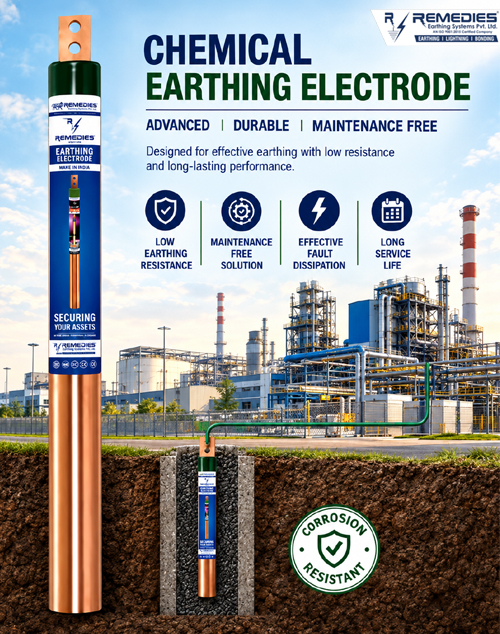
Chemical Earthing Electrode - Ask any electrical contractor what keeps them up at night before a site inspection, and earthing usually comes up somewhere in the conversation. That's where a Chemical Earthing Electrode earns its keep. It's basically a copper or GI rod, filled with a conductive backfill compound, that gets buried in the ground to give fault current a safe way out. What makes it different from the earthing rods your father's electrician used is that the compound inside keeps working even when the soil around it dries up in peak summer — no waiting for rain, no watering the pit every few weeks.
We at Remedies Earthing Systems Pvt Ltd have been making these in our Lucknow plant since 2006, and if there's one thing years of site visits have taught us, it's that a good Chemical Earthing Electrode saves people from a lot of repeat callbacks down the line.
Remedies Earthing Systems Pvt Ltd provides the award-winning services regarding Lightning and Earthing protection system provider with more than 18 years’ experience. We are providing a complete solution to all your Earthing, Lightning protection, surge Protection, electricity safety systems and transient over voltage protection requirements.
Why Choose Remedies Earthing Systems?
Standard of Excellence | Tested & certified Products | Cost Effective |
Customer Focus | Commitment to Accuracy | Easy to Customize | Unique Designs
Types of Chemical Earthing Electrode
Chemical Earthing Electrode Types: There isn't a single "best" electrode — it really comes down to the soil you're dealing with, the budget on hand, and how critical the equipment being protected is. We make a handful of variants for exactly this reason, and most projects end up using more than one type across the site.
Types of Chemical Earthing Electrodes
- GI Chemical Earthing Electrode – This is made from galvanized iron and commonly used for industrial and commercial installations.
- Copper Chemical Earthing Electrode – Provides excellent electrical conductivity and corrosion resistance.
- Copper-Bonded Chemical Earthing Electrode – Steel core bonded with a thick copper layer for durability and long service life.
- Pipe-Type Chemical Earthing Electrode – A perforated metal pipe installed vertically in the ground with conductive backfill compound.
- Maintenance-Free Chemical Earthing Electrode – Uses an earthing electrode with conductive backfill compound to provide stable and low earth resistance with minimal maintenance.
- Plate-Type Chemical Earthing Electrode – Uses a copper or GI plate buried in an earthing pit along with conductive material.
- Rod-Type Chemical Earthing Electrode – A driven rod electrode surrounded by conductive backfill compound, suitable where deep earthing is required.
- Strip-in-Pipe / Pipe-in-Pipe Electrode – Specialized electrode designs that can provide enhanced corrosion protection and extended service life.
The GI Earthing Electrode (our RESPL-G40, G50, and G80 models) is the workhorse — hot-dip galvanized, strip-in-pipe construction, and it does the job well for standard commercial and residential setups without stretching the budget.
Then there's the Copper Bonded Earthing Electrode (RESPL-CBE40/50/75), Chemical Earthing Electrode which is a mild steel core with 99.9% pure electrolytic copper bonded onto it. You get near-copper performance without paying full copper prices, which is why it's probably our most-ordered product. We also do a rod version of this, the Copper Bonded Earth Rod (CBR series, 14mm to 25mm), which happens to be UL listed.
Where nothing but the best will do — think data centres, telecom exchanges, anything running sensitive electronics — the Pure Copper Earthing Electrode (RESPL-Cu40/50/75) is 99.9% copper, no compromises. Costs more upfront, sure, but it dissipates fault current faster and simply lasts longer.
We also make an Electrolytic Earthing Electrode range (GEEE, CBEEE, CuEEE, all at 50mm) Chemical Earthing Electrode built for equipment that just can't handle resistance swings, and a Mobile Earthing Electrode, the RESPL-MOBI65, which is honestly one of our more interesting products — it's portable, non-corrosive, and can be reused up to 72 times, so field teams love carrying it around instead of digging a fresh pit every time.
Chemical Earthing Electrode Specifications, Benefits & Price
Chemical Earthing Electrode Specification: Every model has slightly different numbers, but broadly: terminal sizes come in 32x6mm, 40x6mm, and 50x6mm across the G, CBE, and Cu ranges, lengths are standardised at 1, 2, and 3 metres, and diameters go from 14.2mm up to 50mm depending on which line you pick. All of them ship already filled with our compressed conductive compound.
If your soil is particularly rocky or dry, we also sell backfill compound separately — the ERIC and EZEE ranges in 10kg, 15kg, and 25kg bags — for topping up an existing pit. Everything's manufactured to IS 3043, IEC 62305, IEC 60364-5-54, and IEC 62561-2/7, and the core range has been through CPRI testing, with a few models carrying UL listing as well.
Benefits-wise, the thing customers mention most is that resistance just stays low, month after month, regardless of what the weather's doing. Copper-bonded and pure copper units need almost no attention once they're in the ground. And because a single Chemical Earthing Electrode often replaces what would've taken two or three conventional ones, you end up digging less and spending less on the pit itself. The certifications help too, honestly — when a client's compliance team asks for paperwork, having ISO 9001:2015, CPRI, and UL backing makes that conversation a lot shorter.
Chemical Earthing Electrode Pricing follows the same logic as everywhere else in electrical work — GI is your budget-friendly option, copper-bonded sits comfortably in the middle, and pure copper is what you pay for when performance matters more than the invoice. If you'd rather not do the maths yourself, our domestic earthing kits (RESPL-DE-14 and DE-17) come as a complete package — rod, compound, and clamp together. For anything larger, Chemical Earthing Electrode really worth getting a site-specific quote, since soil resistivity changes the numbers more than people expect.
FAQ: Chemical Earthing Electrode
1. What is a Chemical Earthing Electrode?
It's an earthing rod or pipe — copper, copper-bonded, or GI — pre-filled with a chemical compound that keeps the surrounding soil conductive throughout the year, not just when it's wet.
2. How does a Chemical Earthing Electrode work?
The compound absorbs moisture from the air and slowly releases conductive salts into the soil, which lowers earth resistance and gives fault current a fast, safe path away from equipment and people.
3. What are the benefits of a Chemical Earthing Electrode?
Stable resistance across seasons, very little upkeep once installed, a longer working life than conventional electrodes, and a smaller footprint since one electrode does the work of several.
4. Where is a Chemical Earthing Electrode used?
Pretty much anywhere reliable grounding is non-negotiable — substations, solar farms, telecom towers, data centres, hospitals, factories, and plenty of residential buildings too.
5. What is used with a Chemical Earthing Electrode?
Usually an earth enhancement or backfill compound (we make ERIC and EZEE for this), an earth pit chamber for access and testing, and clamps or couplers to tie it into the rest of the earthing system.

 Inquiry